
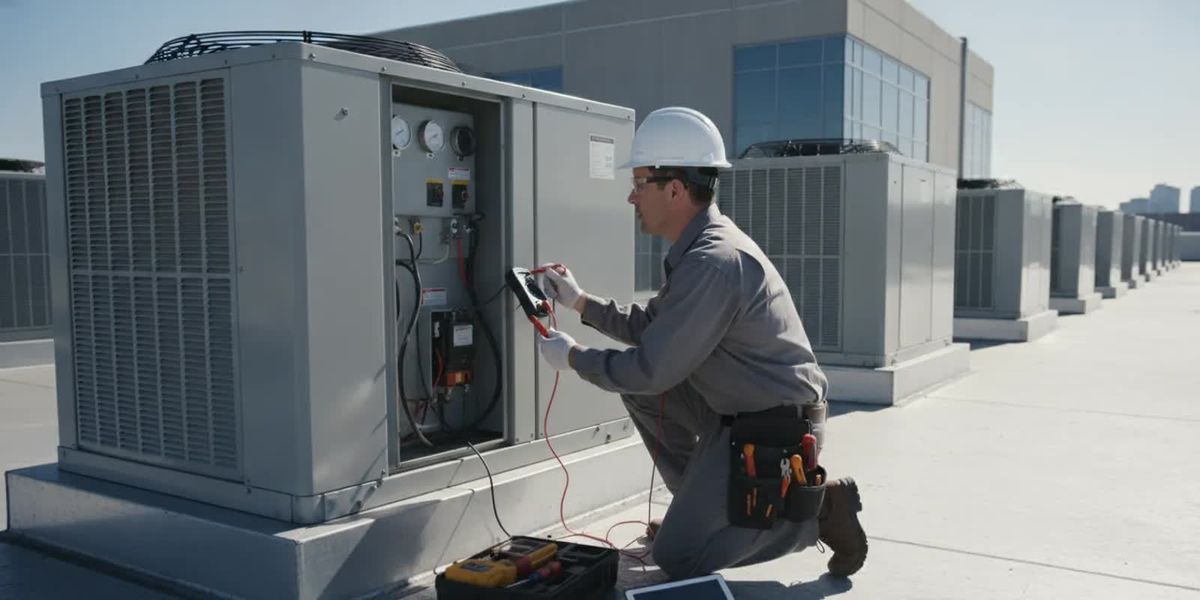
When commercial cooling stops, emergency air conditioner repair may be needed to limit disruption and help staff decide what to do next. Start with people and building conditions, make only safe observations from normal controls, and contact a commercial HVAC provider when the issue is not a simple operating setting.
What should staff check first during an AC outage?
Begin with safety, not troubleshooting. If staff notice smoke, a burning odor, sparks, visible equipment damage, or water near electrical equipment, keep people away from the affected area and follow the facilityâs emergency procedures. Do not open electrical panels, remove equipment covers, or attempt a repair. When a condition may put people at risk, use the siteâs established escalation process rather than waiting to see whether the system starts again.
If there is no immediate hazard, record what staff can observe without touching components. Check whether cooling is lost throughout the building or only in one room or zone. Note whether the normal thermostat or building control display is blank, showing an alert, or set differently than expected. Listen from a safe location for a change in operating sound, repeated starts and stops, or unusual noise.
Which rooms, floors, or zones are affected?
When was cooling last known to be normal, and when did the problem first appear?
Does the equipment seem stopped, or does it appear to be running without cooling the space?
Are doors, loading areas, or windows being left open, or has building use changed?
Was there a recent power interruption, construction activity, or other change near the affected equipment?
Are there displayed alerts, unusual odors, visible leaks, or sounds that staff should report?
These observations can help describe the problem, but they do not identify its cause. Similar symptoms can have different explanations, and an alarm code should be reported exactly as displayed rather than interpreted as a diagnosis. Avoid repeatedly resetting equipment, changing unfamiliar control settings, bypassing a safety device, or touching refrigerant lines or electrical components. If an established operating procedure allows a routine control adjustment, follow that procedure and record what changed.
How should a business decide how urgent the outage is?
The temperature is only one part of the decision. Consider what the affected area is used for, who is working there, what equipment or materials depend on stable conditions, and how quickly the situation is changing. A small zone with no sensitive operations may have a different immediate impact from a broader outage affecting occupied work areas or essential business processes. Staff should communicate the actual impact, not assume a particular repair priority based on the symptom alone.
Use a short operational assessment to organize the response:
People: Are employees, customers, or other occupants in the affected space? Does the facility have procedures for relocating people or limiting access?
Operations: Which work areas or processes are disrupted, and can they continue safely elsewhere?
Equipment and materials: Are there sensitive devices, stored materials, or processes that depend on the space remaining within an operating range?
Trend: Is the indoor temperature stable, rising, or unknown? Record readings only if staff can do so with ordinary approved instruments and without entering a hazardous area.
System condition: Is there a warning, visible damage, water, odor, or abnormal sound that changes the safety concern?
Do not treat the fact that a unit is still running as proof that it is safe to operate. If staff cannot interpret a warning or are uncertain about an unusual condition, keep clear and ask for qualified guidance. Workplace safety responsibilities and guidance are available from the Occupational Safety and Health Administration; follow the facilityâs own safety procedures for the situation at hand.
What information helps when requesting emergency air conditioner repair?
A clear service request lets the provider understand the setting, symptoms, and business impact. Before calling, gather the facility address, a callback number, the business name, and the name or role of the person coordinating the request. State whether the site is in New Hampshire, Rhode Island, or Massachusetts outside Cape Cod. If you are coordinating for an owner or property manager, explain who can approve service and how to reach that decision-maker.
Describe the equipment as far as you know it. Helpful details may include whether it is a rooftop unit or another commercial system, where it is located, any visible model information, and which spaces it serves. Do not delay a call because you do not know the model or technical terms. A straightforward account of what staff saw, heard, and when it began is more useful than a guessed diagnosis.
Report any alert exactly as it appears. Include whether the problem is constant or intermittent, whether staff noticed a recent power interruption or building change, and whether the system has been restarted under an approved procedure. If someone made a routine control change, explain what was changed and what happened afterward. Keep the distinction between observed facts and assumptions clear.
Then explain the operating impact. For example, say that cooling is lost in two occupied office areas, the temperature has been rising since mid-morning, and a specific room must remain accessible for a scheduled operation. That is more actionable than saying only that âthe AC is broken.â Mention access requirements for a roof, mechanical room, loading area, or tenant suite, as well as any site sign-in or escort process.
For service details, the companyâs commercial air conditioning service page describes its commercial air-conditioning offering. B&B Mechanical Services serves businesses across New Hampshire, Rhode Island, and Massachusetts excluding Cape Cod. Same-day service may be available depending on location and technician availability; it is not a guaranteed arrival time or guarantee that a repair will be completed that day.
What should staff do while waiting for service?
Keep the affected equipment and work area accessible, and continue following the facilityâs safety and occupant procedures. If the site has an approved process for reducing avoidable heat gain, staff may follow itâfor example, managing doors or windows and reviewing equipment loads under normal operating policy. Do not disable alarms, move equipment, or change system settings unless authorized and safe to do so.
Protect the technicianâs access and the facilityâs information. Identify who can meet the service provider, arrange any required roof or mechanical-room access, and make relevant equipment labels or site records available. If access is controlled, tell the person arranging the visit how to obtain entry. Do not create an unsafe route or climb to equipment simply to take a photograph or read a label.
Keep a brief event log. Record the time the issue began, areas affected, readings if normally collected, new alerts or symptoms, and any action staff took under site procedures. If the conditions change, update the service provider. This record can make an intermittent issue easier to describe and help separate a one-time observation from a repeated pattern.
Businesses should also follow their own escalation process if the conditions pose a risk to people, operations, or sensitive materials. A service request does not replace internal decisions about restricting access, relocating work, or safeguarding materials. Those decisions belong to the responsible facility personnel, based on the siteâs procedures and the circumstances.
What should a business clarify with the contractor?
Before authorizing work, make sure the person approving service understands the diagnostic or repair step being proposed. Ask what the technician has found, what action is recommended, and whether approval is needed before additional work proceeds. Clarify how findings and any estimate will be communicated, and who the provider should contact if the person on site cannot authorize a change in scope.
Ask practical questions about the visit without assuming a specific diagnosis or arrival time:
What information or access should the facility have ready?
Will the provider need a site contact, escort, roof access, or a mechanical-room key?
What is the next step after the initial assessment?
How will the provider communicate findings and any proposed additional work?
Does timing depend on the site location, equipment, or technician availability?
Answers can depend on the equipment and what inspection reveals. A call about urgent cooling does not by itself establish the cause, scope, cost, or completion time. Ask for the information needed to make an informed authorization decision before work proceeds.
For a closer description of the available service, review B&B Mechanicalâs commercial AC service information. The page is a service overview, not a promise that every system issue will have the same remedy or schedule.
How can facility teams prepare for a future outage?
A few basic records can reduce confusion when a system stops cooling. Keep a current list of equipment locations, the spaces each system serves, and the person authorized to request and approve service. Where available, retain model or asset information and the location of relevant controls. Make sure staff know which routine control actions are permitted and which conditions require them to stop and escalate.
For buildings with several systems, record which zones are connected to which equipment. If one area has recurring symptoms, note dates, conditions, and any prior service findings. A simple log can help the facility manager explain whether the current event resembles an earlier problem, without treating the record as a substitute for inspection.
Planned maintenance can give a business a regular opportunity to review equipment condition and discuss observed changes with a service provider. It cannot guarantee that a breakdown will not occur. Facility teams can ask what maintenance covers, how often visits are planned, how findings are reported, and how recommendations are authorized. Keep agreed scope and records with the equipment files so staff can find them during an urgent call.
For organizations managing multiple locations, use a consistent outage-reporting format across sites. Ask each site contact to record the address, equipment or zone affected, symptom start time, operational impact, alert details, access requirements, and approving contact. A consistent report helps central facilities staff compare the information they receive without assuming that the same symptom has the same cause at every building.
Review commercial air-conditioning service
Frequently asked questions
Should staff reset a commercial air conditioner?
Only use a routine control action when it is allowed by the siteâs approved procedure or the manufacturerâs operating instructions. Do not repeatedly reset equipment, bypass a safety device, or open panels. If an alert persists or the system stops again, report the observation and request qualified service.
Does emergency service mean same-day repair is guaranteed?
No. Same-day service may be available depending on location and technician availability, but it should not be treated as a guaranteed arrival time or a promise that the system will be repaired that day. Ask the provider about current options for the facility.
What details should a facility manager have ready?
Have the site address, callback information, equipment location or type if known, affected areas, observed symptoms, start time, displayed alerts, and business impact ready. Also identify the person who can authorize work and explain any access constraints.
Can staff identify the cause from an alarm or symptom?
An alarm or symptom is useful information to report, but it may have more than one cause. Record exactly what appears or happens and leave technical diagnosis and repair to a qualified HVAC professional.
A clear account of the symptoms, site conditions, and operational impact gives a commercial HVAC professional a practical starting point for assessing an urgent cooling problem. When your facility needs help, call to discuss the commercial AC issue and the next steps.