
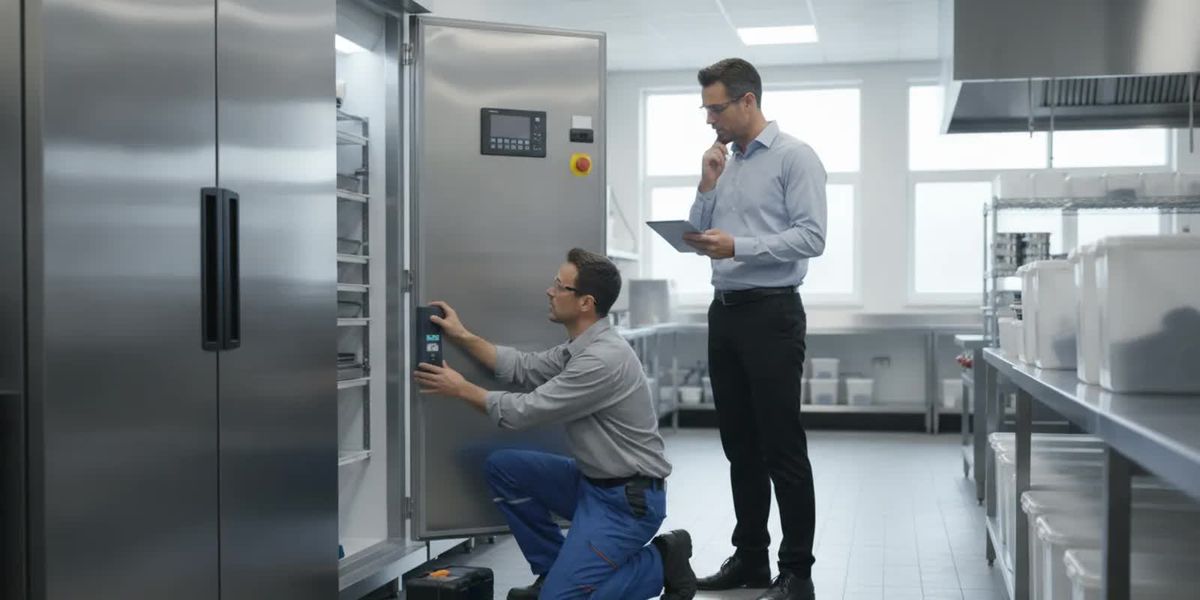
A refrigeration problem can quickly disrupt a commercial operation, but a prepared team can make the first decisions more calmly and give a technician useful information. If you are asking how much does a walk in freezer cost, first separate the immediate service need from a possible repair or replacement: the cost depends on what is found and what work is approved. A clear emergency plan helps your team respond without guessing at the fault, the price, or product safety.
Request commercial refrigeration service by phone
What should a business do first when refrigeration fails?
Start with people, the immediate situation, and your site’s established procedures. Do not open electrical panels, handle refrigerant, or try to repair equipment unless you are qualified and authorized to do so. Keep employees and customers away from anything that could be hazardous, and alert the person responsible for facilities or operations.
Identify which equipment is affected. Determine whether the concern involves a walk-in freezer, walk-in cooler, or another commercial refrigeration system. Note whether other units appear to be operating normally. Do not assume multiple units share a fault just because they are in the same building.
Record what you can safely observe. Note an alarm or display message, unusual sound, visible water, a door that is not closing, or a change in normal operation. Do not remove covers or touch wiring, moving parts, or leaking material to investigate.
Follow internal escalation procedures. Notify the designated facility lead and use the organization’s established process for affected goods, restricted access, and operational decisions. Do not make up holding times or decide that goods are safe based on appearance.
Request qualified service. Explain the observed symptoms and the business impact. Ask what information or site arrangements are needed to assess the request.
B&B Mechanical Services provides commercial refrigeration service, including work on walk-in coolers and freezers. The commercial refrigeration service page describes the service offering. Availability and the work required depend on the circumstances; a request does not establish a diagnosis, arrival time, or completion time.
What information should you gather before calling?
You do not have to diagnose the system. Your goal is to provide clear observations so the service team can understand the request and coordinate the next step. Collect information that is safe to access and readily available, but do not postpone an urgent call while searching for every detail.
Site and access: business name, service address, best entrance, sign-in requirements, and a contact who can provide access or escort a visitor.
Equipment identity: whether it is a walk-in freezer, walk-in cooler, or other system; its location in the facility; and, if visible without removing a panel, the make, model, or equipment label.
Symptoms: whether it is not running, showing an alarm, making an unfamiliar sound, or behaving differently from normal. Record the exact display message if you can read it safely.
Timing: when the concern was first noticed, whether it has changed, and whether the issue is continuous or intermittent. Distinguish direct observations from assumptions about the cause.
Operational impact: which unit or area is affected, what business activity depends on it, and whether your internal escalation or inventory procedures are underway.
Recent context: known recent service, repairs, changes in use, or relevant records. Share only what is known; do not attribute the fault to a recent event without evidence.
A concise report might be: “The walk-in freezer alarm appeared at 7:15 a.m. The display shows code X. The door appears closed, and the issue was first noticed during the opening check. One unit is affected.” That gives a service professional observations and timing without claiming that a particular part has failed. If the display changes, record the new message and when it appeared.
How can a facility prepare before an emergency?
Preparation is most useful when the information can be found by the person who receives the call, even if the regular facilities contact is away. Keep a short equipment and response record for each site. It should be easy to update and available to the staff members who may need to report a problem.
Build a usable equipment record
For each system, record its location, equipment type, visible identifying information, and the room or operation it supports. Note which staff member or team owns the record. If your organization has several locations, label records by site and identify each unit in plain language, such as “rear receiving walk-in freezer,” rather than relying only on an internal asset code. Keep equipment manuals or service records with the entry when practical, but do not make them a prerequisite for calling for help.
Update the file after equipment changes or service visits. If a technician’s report names the equipment differently from your internal label, include both descriptions so the next caller can connect the service record to the physical unit. A simple, current record is more useful during an incident than a detailed document that staff cannot locate.
Agree on who reports, approves, and coordinates
Set out who is allowed to report an issue, who can arrange access, and who can approve work under your organization’s purchasing and facilities rules. Choose a backup for absences and after-hours situations. Make sure the people who may be on site know how to reach the decision-maker or follow the escalation chain. This planning clarifies internal responsibilities; it does not promise a contractor’s availability or dispatch timing.
Separate the person who observes a problem from the person authorized to approve a repair if those roles differ. The observer should know to report the facts promptly, while the approver should know how to review the diagnosis, scope, and estimate. This avoids a preventable pause when a technician has identified a proposed next step but the authorized contact is not clear.
Make site access and safety instructions clear
Write down the correct entrance, parking or loading-area instructions, sign-in process, restricted spaces, and escort requirements. Keep the information current and provide relevant instructions when requesting service. If the site has special safety rules, explain them during coordination rather than expecting a visitor to discover them on arrival. Do not leave keys, access codes, or sensitive security information in a widely shared equipment log.
Keep a simple incident and service timeline
A short timeline can help staff give consistent updates. Record when a symptom was first noticed, who was notified, when service was requested, what information was shared, and any next step discussed. After service, add the technician’s findings and the work authorized. Keep observations separate from conclusions: “alarm appeared at 7:15” is an observation; “the compressor failed at 7:15” is a diagnosis that should come from an appropriate assessment.
What should you ask when requesting commercial refrigeration service?
A good service call is a two-way exchange. Share the facts you have, then ask practical questions about assessment, access, and approvals. You can also review the commercial refrigeration service information to confirm the relevant service category.
What equipment details or symptoms would help you understand the request?
What access arrangements should we make at the facility?
How will the equipment be assessed, and how will the findings and recommended work be explained?
How will the proposed scope and estimate be reviewed before work proceeds?
What should our staff do or avoid doing while waiting for the assessment?
Who should receive updates, and what information should be available to that person?
An initial call is not the same as an on-site diagnosis or a fixed estimate. The cause, condition, parts required, and appropriate scope may not be known until the equipment is assessed. Ask for the proposed work and cost information in a form your authorized decision-maker can review, and follow your organization’s approval process before work begins.
How much does a walk-in freezer cost during an emergency?
The phrase how much does a walk in freezer cost can refer to several different decisions: the cost of diagnosing a problem, a repair, replacement of a component, or replacing the walk-in system. Those are not interchangeable. The appropriate amount depends on what equipment is involved, its condition, the issue found, the work proposed, and the details of the approved scope. B&B Mechanical Services has not provided a universal price schedule for this article, so a generic online figure should not be treated as a quote for your facility.
When you receive a recommendation, ask the service professional to explain the following in plain language:
What was observed? Ask which unit was assessed and what condition or symptom supports the recommendation.
What work is proposed? Clarify whether the recommendation is diagnostic work, a repair, a component replacement, or a larger replacement project.
What is included in the estimate? Confirm the described scope and any assumptions or unresolved details. Avoid treating an estimate for one defined task as the cost of every possible repair.
Are there alternatives to consider? Where appropriate, ask whether there is another practical option and what differences in scope it involves. The available choices depend on the findings; do not assume every repair has a like-for-like alternative.
What approval is needed? Confirm who must authorize the work and whether the estimate or scope should be documented before proceeding.
This approach gives the business a basis for making a decision without inventing a price or assuming a repair outcome. For context about the company’s service category, see its commercial refrigeration service page. If the situation involves broader commercial heating or cooling needs, B&B also describes its commercial HVAC systems service.
How should staff handle goods that may be affected?
Equipment service and product-handling decisions are related, but they are not the same task. Staff should follow the business’s established food, inventory, or product-safety procedure and escalate questions to the person responsible for those decisions. Do not use a guessed temperature limit, elapsed time, or appearance as a substitute for the organization’s procedure or applicable guidance.
Keep a factual record of the information available to the decision-maker, such as the unit involved, the time the concern was noticed, and any readings obtained through the facility’s normal process. Do not put staff at risk to collect a reading or enter an unsafe area. For general food-safety resources, consult the U.S. Food and Drug Administration’s food resources (FDA, accessed 2026); use the guidance relevant to your operation and follow your own applicable procedures.
If there is uncertainty about whether items can be used, moved, or discarded, route the question to the designated internal decision-maker rather than asking a refrigeration technician to make a business’s product-disposition decision. Clear separation of responsibilities helps staff address the equipment issue and product question without conflating them.
What should you avoid during a refrigeration emergency?
Do not attempt unqualified technical work. Avoid opening electrical compartments, handling refrigerant, or working on moving components unless properly qualified and authorized.
Do not declare a cause before assessment. An alarm or unusual sound is useful information, but it does not prove which part has failed.
Do not make unsupported promises to colleagues. A reported symptom does not establish a repair scope, arrival time, restoration time, or final cost.
Do not assume products are safe or unsafe without following the right process. Use the business’s established procedures and refer questions to the designated person.
Do not delay the call while assembling a perfect file. Report the important facts you have, then provide additional information when available.
Do not leave responsibility unclear. Identify the person who can provide access and the person authorized to approve work.
How can you reduce confusion after requesting service?
Assign one person to coordinate updates where possible. That person can maintain the incident timeline, share relevant changes with the service contact, and keep internal stakeholders informed. If a new alarm appears or the situation changes, record when it happened and pass along the update. Do not ask multiple staff members to provide conflicting versions of the same event when one coordinated report will do.
When findings are explained, repeat back the key points: which unit was assessed, what was observed, what work is proposed, what the estimate covers, and whether approval is required before the work starts. Ask for clarification when terms are unfamiliar. Then save the service record with the equipment file so the next maintenance or service conversation has useful context.
For businesses with more than one facility, note the site and unit on every message and record. A report that says “freezer down” may be ambiguous when several locations have similar equipment. Adding the site name, room, and unit label makes it easier for the right people to track the incident and related service history.
Frequently asked questions
Should we wait until the freezer stops working completely before calling?
No. If staff observe a concerning change or alarm, follow site procedures and contact a qualified commercial refrigeration professional for guidance. Describe what has changed rather than waiting for a complete failure or trying an unapproved fix.
Can a technician diagnose the issue over the phone?
A call can communicate symptoms and help coordinate a request, but it does not replace an assessment of the equipment. Provide accurate observations and ask what the next step is.
Is same-day service guaranteed?
No. Same-day availability may depend on location and technician availability. A request does not establish a guaranteed arrival time or completion time.
Should we repair or replace a walk-in freezer?
That decision depends on the equipment’s condition, the issue found, the proposed scope, and the business’s needs. Ask the technician to explain the findings and available options so an authorized decision-maker can evaluate them.
Can we get a reliable cost before the equipment is assessed?
A general article or initial call cannot establish the specific cost for your equipment. Ask for the diagnosis and an estimate tied to the proposed scope, then review it through your normal approval process.
Call to discuss a commercial refrigeration service need
A current equipment record, clear staff roles, and a consistent escalation process help your business respond with better information when refrigeration problems arise.