
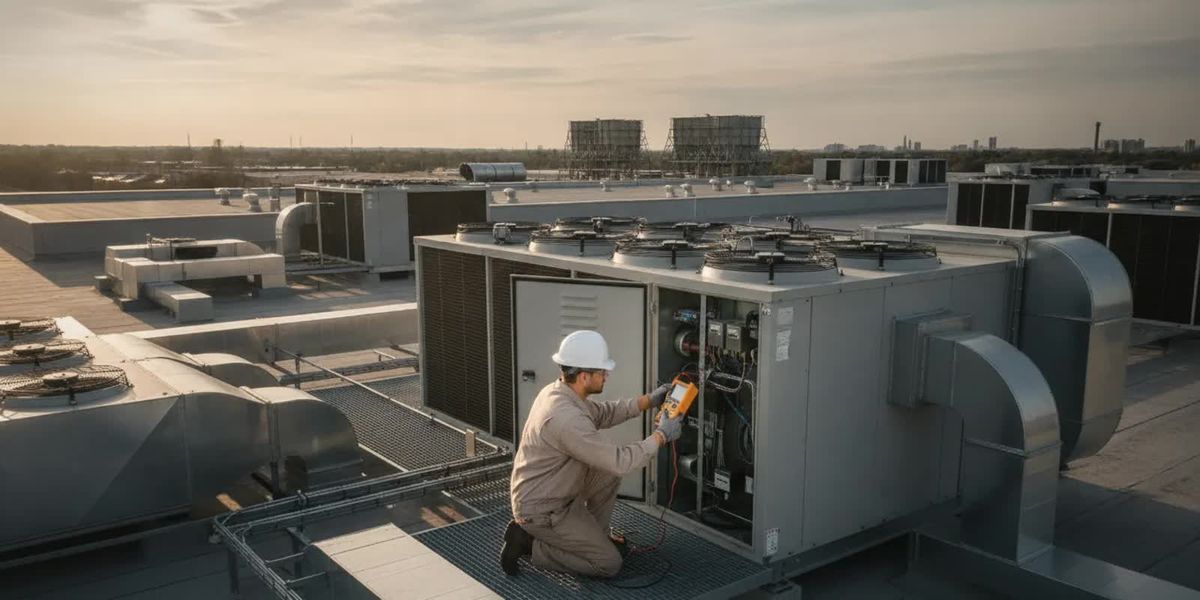
When a commercial system needs attention, hvac replacement cost is only one part of the decision. Facility managers also need to understand the equipment condition, what a repair would address, and what replacing the system would involve at that site. A structured comparison keeps the decision grounded in findings instead of assumptions or a price copied from another building.
What does commercial HVAC replacement cost depend on?
There is no single price that applies to every commercial HVAC replacement. Project scope depends on the existing equipment, the system serving the building, site conditions, and the work needed to complete the change. Two units that appear similar may be installed in different settings or serve different operational needs.
Separate the equipment decision from the installation scope. Equipment selection concerns what system is appropriate for the building and its use. Installation scope concerns the work needed to remove, connect, configure, and verify the equipment. A preliminary discussion may identify factors to investigate, but it should not be treated as a project-specific estimate without relevant equipment and facility details.
Equipment type and what it serves
A rooftop unit, boiler, and other commercial heating or cooling equipment have different requirements. Make an inventory of the equipment under consideration: type, location, available model information, and spaces served. Note whether other equipment or controls are connected to it. If the building use or layout has changed, include that context rather than assuming the old configuration still fits.
A label can help identify a unit, but it does not establish the right replacement by itself. The equipment’s role in the overall system and the conditions at the property also matter. An assessment can clarify which information is available and which details need confirmation before comparing options.
Condition, symptoms, and repair history
Age is one piece of context, not a diagnosis. Record recurring problems, prior service findings, and how the system behaves now. Note whether a symptom is constant or intermittent, when it occurs, and which areas are affected. A repeat issue may have a different cause from a one-time disruption, and similar symptoms can arise from different conditions.
Ask what was observed and what evidence supports the diagnosis. A repair recommendation should identify the problem the work is intended to address. A replacement recommendation should explain why the proposed change fits equipment condition and facility needs. If the cause is uncertain, ask what diagnostic step would clarify it before treating either option as settled.
Installation and site conditions
Access can affect the required work. Consider whether equipment is on a roof or in a mechanical room, what site procedures apply, and whether work areas need coordination with building operations. Existing connections, controls, removal requirements, and the planned sequence should be described where relevant.
Ask which parts of the project have been inspected and which are assumptions. If site access or another detail has not been confirmed, find out how uncertainty could affect scope. This is more useful than comparing headline figures that may describe different tasks.
How should a facility compare repair with replacement?
Compare options using consistent questions while recognizing that they are not identical kinds of work. A repair addresses a diagnosed issue in existing equipment. Replacement changes the equipment and involves an installation plan. Neither path is automatically right for every building. A rule based only on age or one symptom can miss important context.
What should a repair assessment clarify?
Finding: What was observed, and what diagnosis supports the proposed repair?
Scope: Which component or problem is the work intended to address?
Remaining concerns: What condition or uncertainty would remain afterward?
Follow-up: Is additional monitoring, testing, or discussion needed?
Operations: What coordination or access should the business consider?
Ask for a clear explanation rather than assuming one repair will resolve every concern with an older system. The commercial HVAC repair page describes diagnostic and repair service; actual work depends on the equipment and conditions at the facility.
What should a replacement assessment clarify?
Equipment covered: Which unit is being replaced, and which parts of the building does it serve?
Proposed equipment: What system is under consideration, and what supports its suitability?
Installation scope: What removal, installation, connection, or controls tasks are included?
Site coordination: What access, work-area, or operating arrangements need planning?
Open assumptions: What needs confirmation, and how could it affect scope?
These questions show whether two proposals are comparable. If one covers tasks another leaves unclear, request clarification before using the figures to choose a path. A lower initial amount does not necessarily represent the same work.
How can you make an apples-to-apples comparison?
Create a written summary for each option. Keep confirmed findings separate from items that still need inspection or approval. A useful comparison does not require a complicated spreadsheet; it requires consistent categories and notes about what is included, excluded, and unresolved.
Identify the equipment. Record its type and location, available identification information, and the areas it serves.
Write down the observed issue. Include when it started, how often it occurs, what changed, and any operational effect. Label observations as observations, not a confirmed cause.
Capture the professional finding. Note the diagnosis, evidence described, and any uncertainty or additional assessment recommended.
Describe each proposed scope. For repair, state the problem and work being addressed. For replacement, list equipment and installation tasks covered.
Mark exclusions and assumptions. Ask about tasks or site conditions that are not stated. Do not infer an item is included just because it is common on another project.
Record operational coordination. Note affected spaces, access procedures, scheduling constraints, and who at the facility needs to be involved.
List unanswered questions. Keep them visible and assign someone to obtain clarification before approval.
This makes differences easier to discuss. If one proposal describes a repair to a diagnosed issue and another describes full equipment replacement, the figures do not represent interchangeable scopes. Compare the expected work and remaining questions, not only the totals.
What does a practical repair-versus-replacement example look like?
Consider a rooftop unit with an intermittent operating problem. Facility staff can note the dates and times the issue appears, the spaces affected, and whether it stops without intervention. They can gather service reports and model information from existing records without opening or altering equipment. Those notes help a technician understand context, but they do not establish the cause.
After assessment, suppose the finding identifies a specific issue and a defined repair. The facility can ask what the repair addresses and what concerns remain. It can then compare that scope with a replacement proposal identifying the equipment, installation tasks, site coordination, and unresolved assumptions. The decision record should make clear that one option concerns the diagnosed problem and the other changes the equipment.
If the assessment does not establish the cause, the next useful comparison may not be repair versus replacement. It may be whether to gather the information needed to clarify either scope. Ask what remains unknown, how it can be assessed, and whether the operational situation requires prompt attention. Do not treat an uncertain estimate as a confirmed diagnosis.
The same approach applies to two replacement proposals. Check whether both address the same equipment and spaces, describe comparable installation work, and identify similar access and coordination needs. A missing detail is a question to resolve, not evidence that the work is included or unnecessary.
What information should you prepare before an assessment?
A focused information packet helps keep the conversation about the actual facility. It need not be elaborate. Gather what is readily available and be clear about what you do not know.
Equipment type and location, plus model or serial details available from records.
A short description of symptoms, when they began, and whether they are intermittent or persistent.
Areas affected and operational constraints the service team should understand.
Recent service reports, recurring issues, and relevant maintenance records.
Known changes to the building, its use, or the spaces served by the equipment.
Site access requirements, contact person, and work-area procedures.
Questions about repair scope, replacement scope, and items needing confirmation.
A symptom log can be brief: date and time, affected area, what staff noticed, and whether the condition changed. Keep it factual. Do not describe a suspected cause as a diagnosis, and do not delay requesting service to create a lengthy history if operations are disrupted. Staff should not move guards or open equipment to simplify an assessment; follow site procedures and leave technical work to qualified personnel. For more on what an assessment may address, review the commercial HVAC repair process.
How should facility managers evaluate operational impact?
Cost is important, but the decision also affects how a facility plans work and communicates with occupants or operating teams. Identify which areas rely on the equipment and what coordination is needed if access or work affects those areas. A warehouse, office, retail space, and production area may have different scheduling considerations, even when equipment type is similar.
Describe practical constraints before work is approved. These may include access windows, site safety procedures, other contractors, or internal approval steps. Ask the service provider what coordination is required and what the current scope assumes. Do not assume every project follows a standard schedule or that an assessment establishes a fixed completion time.
For a property manager responsible for multiple sites, keep the decision record specific to each building. Similar equipment across locations does not mean identical symptoms, access conditions, or installation needs. A consistent checklist can help compare information, but findings and proposed scope should remain tied to the individual facility.
What questions should you ask before approving work?
What findings support the recommendation, and what remains uncertain?
For a repair, what diagnosed problem is the work meant to address?
For replacement, what equipment and installation tasks are included?
Which tasks, materials, or coordination items are excluded or unconfirmed?
Are there access, work-area, or operational arrangements the facility must make?
What information would change scope or help make options comparable?
Who should review the recommendation, service records, and project assumptions?
Answers should help the business understand the proposed work and decide based on its equipment and needs. If a proposal is unclear, ask for the missing detail in writing. The objective is not to force a repair or replacement choice before the facts are available; it is to understand what each choice addresses.
How can maintenance help with future planning?
Organized service records help facility teams notice recurring issues and provide context for future assessments. Keep reports with dates, equipment identification, reported symptoms, findings, and work completed. When a concern returns, those records can help distinguish a repeated pattern from a new observation.
Maintenance is not a guarantee against breakdowns, and a maintenance visit alone does not determine when equipment should be replaced. Its planning value is in keeping equipment condition and service history visible. Facility managers can use that information to raise questions, coordinate attention, and avoid relying on memory when discussing options.
Where a business manages several buildings, use a consistent way to organize records, but do not assume every site follows the same plan. Document building-specific equipment and conditions. Periodically review open items with operations and budget decision-makers so unresolved concerns do not disappear between service calls.
How do building requirements affect replacement planning?
Requirements can vary with equipment, building, and jurisdiction. Ask which site approvals, access rules, or other project requirements apply and who is responsible for confirming them. Do not assume a general article or another facility’s project establishes what is required at this property.
The U.S. Department of Energy provides general information about energy use and efficiency at its official website. That broad resource is not a project-specific code determination or equipment recommendation. Confirm applicable requirements for the facility and proposed work with appropriate qualified professionals and authorities.
Coordinate communication with staff who use affected spaces. A clear plan identifies the facility contact, areas involved, and site procedures. Make arrangements based on actual scope rather than assumptions about a typical installation.
Frequently asked questions
Can HVAC replacement cost be estimated without assessing the system?
A preliminary conversation can identify factors that may affect scope, but a useful project-specific estimate depends on equipment and facility details. Ask which assumptions are being made and what needs inspection or confirmation.
Does the age of a commercial unit alone mean it should be replaced?
No. Age is context, but condition, diagnosed problems, service history, installation needs, and the building’s current requirements also matter. An assessment can help explain options for the actual system.
Should a business repair equipment before considering replacement?
Not in every situation. The appropriate path depends on the diagnosed issue, equipment condition, facility needs, and scope of each option. Compare findings and proposed work rather than applying a universal rule.
What should I bring to a repair-versus-replacement discussion?
Bring available equipment information, service records, a factual description of symptoms, affected areas, site access details, and operational constraints. Identify what is not known so it can be clarified.
How can I compare two estimates fairly?
Check whether they cover the same equipment, work, and site coordination. Review exclusions and assumptions, and request clarification where details differ or are missing. Do not rely only on initial figures if scopes are not comparable.
Schedule a call to discuss your facility
Gather available equipment and service information, then discuss findings and possible scopes with a qualified commercial HVAC service provider before approving work.