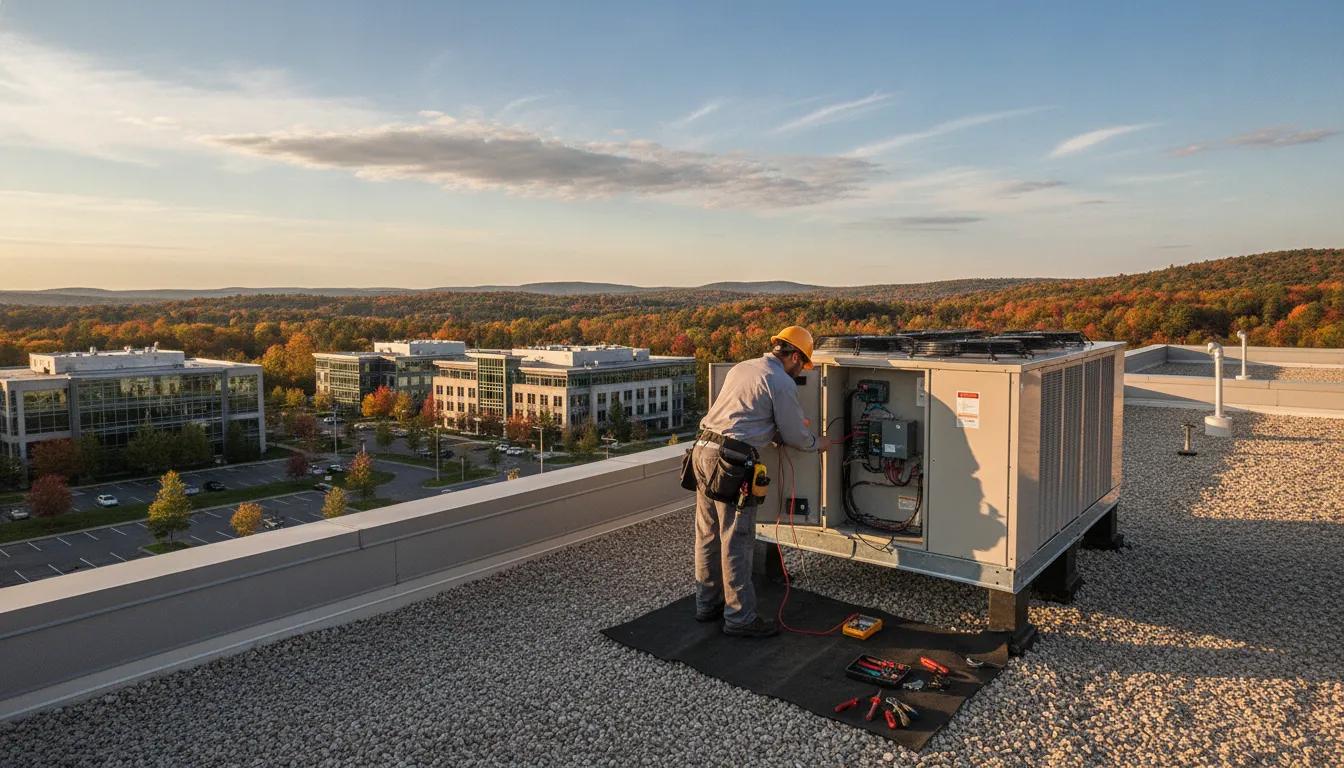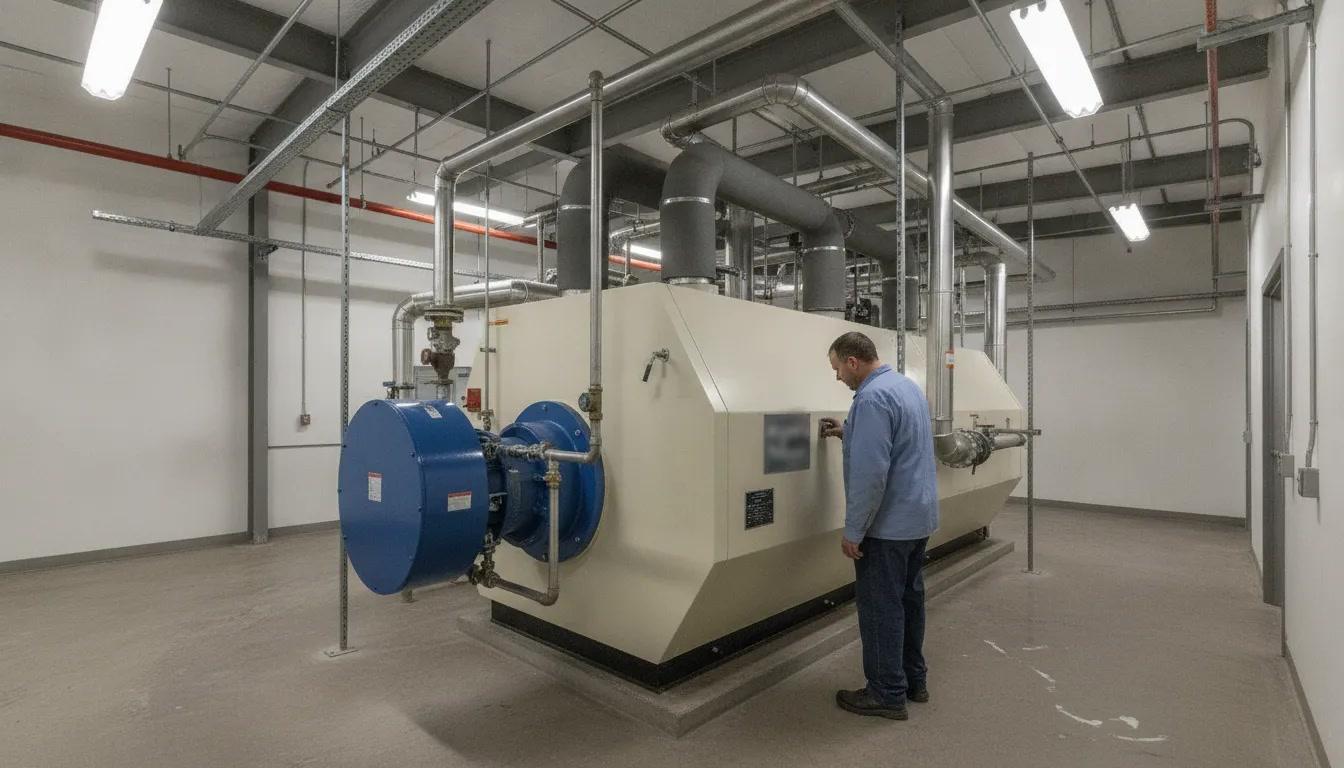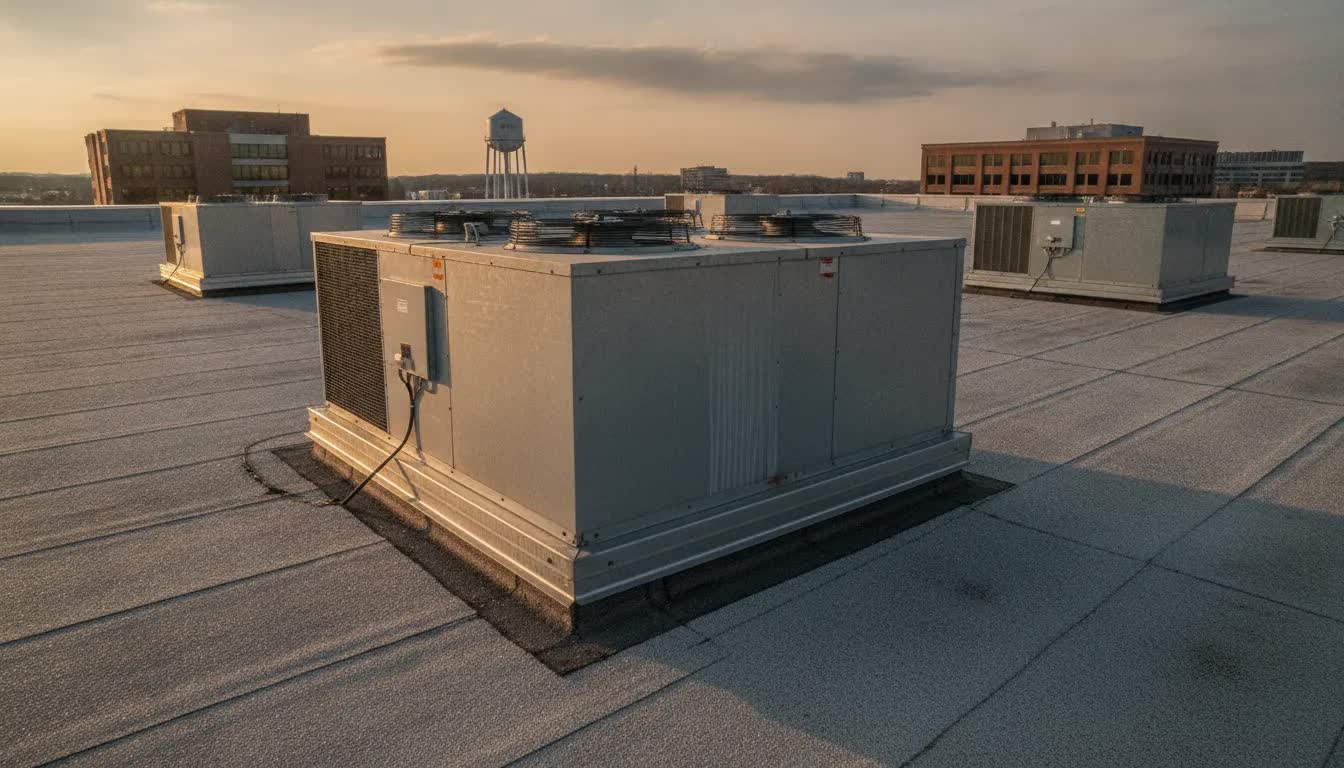
A new squeal, rattle, or low rumble from the roof is easy to put off until a sales floor or office complains. Commercial rooftop HVAC noise is not one problem. A packaged rooftop unit has several sound sources, and each one points a facility manager toward a different next step. Some sounds are the normal note of fans and compressors. Others mean a belt, a fastener, or a bearing is getting worse and should be diagnosed before the unit stops cooling or heating the building.
B and B Mechanical Services has repaired commercial rooftop equipment for businesses in New Hampshire, Massachusetts excluding Cape Cod, and Rhode Island since 2000. If the sound is new, louder than last week, or paired with warm rooms or a unit that will not stay running, call (978) 667-4644 and ask for commercial rooftop repair. A technician can diagnose the unit and explain the repair before any work starts.
What commercial rooftop HVAC noise usually includes
A packaged rooftop unit is supposed to make noise. Condenser fans, the supply fan, and the compressors each have their own sound. The curb under the cabinet can carry some of that into the space below. ASHRAE Journal's discussion of large rooftop units treats the cabinet as several sources, not one hum. Compressors, condenser fans, supply fans, return fans, and exhaust fans each add a different sound. The path into the room matters as much as the source. A unit parked over a quiet office will be judged more harshly than the same unit over a stockroom.
For a facility manager, the useful comparison is the unit's own baseline. A steady fan whoosh is ordinary. So is a compressor that comes on with the cooling call and then settles. A sound that was not there last month is the change worth writing down. So is a sound that gets louder through the day, or a vibration you can feel in the ceiling tile under the curb.
Design-level noise in a conference room is a different question from a unit that has started to grind. Acoustical goals, duct layout, and curb isolation are decided when the unit is specified. This article is about the second question: a unit already in service whose sound has changed. That change is a maintenance and repair clue, not a reason to redesign the roof.
How the sound reaches the occupied space
People rarely hear the rooftop unit the way it sounds standing next to the cabinet. They hear what comes through the curb, the duct, and the ceiling. A supply fan can send sound down the duct and out of a diffuser. The same fan can also vibrate the curb and show up as a buzz in the tiles directly below. Two complaints can share one unit and still need two notes. One is loud air at the diffuser. The other is a hum in the ceiling.
Short duct runs are common on commercial roofs because they cost less and move air with less fan energy. They also put the cabinet closer to the people it serves. If a renovated office suddenly sits under a unit that used to serve a warehouse bay, the equipment may not have changed at all. The receiver did. Say so when you call. A technician still needs to rule out a new mechanical fault, but the history keeps the visit honest.
Weather adds its own path. Wind across a loose panel, rain on an open access door, and ice on a fan guard all change what the floor hears. A sound that only appears on windy days is still worth a look on the next planned visit. A sound that stays after the weather clears is more likely mechanical.
Squealing usually points at the blower belt
A high squeal when the blower starts, or a squeal that comes and goes with the fan, is a common belt complaint on belt-drive rooftop units. The belt can be glazed, loose, cracked, or close to breaking. A squeal on startup that then settles can still be a belt that fails on a hot afternoon. That is a bad time to lose airflow on a sales floor or a kitchen line.
Do not treat a belt squeal as something to tighten from the roof hatch. Belt tension, sheave alignment, and the condition of the blower bearings belong in a service visit. A belt that was tightened without alignment often squeals again, and it can wear the pulley. If the squeal is new, note whether it happens only at startup or the whole time the fan runs. Also note whether any floor has lost airflow. That is enough for the office to put the call on the schedule.
Direct-drive fans do not have this squeal. If you know the unit is direct drive and you still hear a high screech, say that on the call. The cause is more likely a motor bearing or a fan rubbing a housing, not a belt you can see through a panel crack.
Rattling and banging are often loose metal
A rattle that changes with fan speed is often a panel, a screw, or debris on the condenser coil. It is not automatically a failed compressor. Wind, roof traffic, and seasonal storms loosen access panels. A panel that ticks against the cabinet can sound serious from the floor below and still be a fastener once someone is on the roof.
Banging is different from a light rattle. A rhythmic bang, a cabinet that shifts on the curb, or a sound like something striking the fan housing should be checked before a blade or a panel does more damage. Internal insulation that has come loose can also flap in the supply air and imitate a mechanical knock. Ice, leaves, and packaging that blew onto the roof can block a condenser fan. Clearing debris from a spinning fan is not a job for building staff.
If your staff is trained and allowed to do it, shut the unit off at the disconnect and then call. Do not prop a panel open and leave the unit running. An open panel changes airflow, and it can turn a rattle into a bigger failure. Photograph the closed cabinet if a panel is visibly out of line, and send that with the request. Do not climb onto the curb to push the panel back into place.
Grinding, clicking, and a hard vibration
Sort the harsher sounds by when they happen, not by how alarming they feel in the hallway.
- Grinding or a growling rumble that tracks the fan often involves a blower or condenser-fan bearing. Bearings get louder before they seize. Waiting until the fan stops usually means a hotter repair and a longer outage for the zones on that unit.
- A rhythmic click or knock that starts when the compressor comes on, and stops when cooling stops, is a compressor or refrigerant-line clue. Scroll compressors can click briefly as they load. A new, steady knock that was not in the normal start sequence should be diagnosed, not run through the rest of the week.
- A hum with a hard vibration in the ceiling under the curb can be an isolator, a sprung mount, or a refrigerant line touching the cabinet. A unit that used to be quiet and now buzzes the office below has changed. That is a service call, not a reason to stack pads on the curb without looking at it.
- Rapid on-off cycling with a short burst of fan or compressor noise is a separate rooftop problem. If the unit starts and stops every few minutes, the short-cycling article on this site is the closer read. Do not treat the burst of noise as the whole story.
None of these sounds tells you the part number from the hallway. They tell you whether to keep operating, watch the unit, or take it offline and call. A burning smell, smoke, or a breaker that trips on startup is not a watch-it item. Shut the unit down if you can do that safely, and request service the same day.
A practical way to sort the complaint
Use the same order every time so the note you send the office is consistent across shifts.
- Name the unit and the area it serves. Roof tags and zone names both help if the building has more than one cabinet.
- Name the sound in one word: squeal, rattle, grind, click, hum, or bang.
- Say when it happens: startup only, the whole time the fan runs, only in cooling or heating, or all night.
- Say whether comfort changed: warm zones, weak airflow, ice on a line, or a unit that will not stay on.
- Say whether anyone on site can safely shut that unit off, and whether it is off now.
That sequence is the failure detail a dispatcher can schedule from. It is not a diagnosis, and it does not replace a look at the belts, bearings, and controls. B and B Mechanical Services explains the recommended repair and waits for approval before the work begins.
What to leave to the technician
Roof access, line voltage, and refrigerant circuits are why this stays a contractor visit. A facility team can listen, write down the pattern, and shut a unit off at a labeled disconnect when policy allows it. Opening the cabinet to tighten a wire, add refrigerant, or swap a capacitor is a different job. Those parts fail in ways that are not obvious from the sound alone, and a wrong guess can take out a compressor that was still serviceable.
The same limit applies to "fixes" copied from a residential condenser. Spring isolators, neoprene pads, and mass added to a curb can be part of a designed installation. They are not a field patch for a grinding blower. If the vibration is new, something in the unit or on the curb changed. Find that change first.
B and B Mechanical Services handles this as commercial rooftop work for warehouses, storefronts, offices, restaurants, and other business properties. The visit covers the rooftop cabinet and the heating or cooling problem it is causing indoors. Technicians work from a diagnosis, not from a phone description alone. After you approve the repair, they complete it and check that the system is running.
When the noise should become a work order
Call for commercial rooftop HVAC repair when any of these are true:
- The sound is new or clearly worse, and it has lasted more than a day.
- You can feel vibration in the occupied space under the unit.
- Airflow is weak, a zone is far off temperature, or the unit will not stay running.
- There is a burning smell, smoke, or a breaker that trips when the unit starts.
- A belt squeal, grind, or bang continues after startup.
A one-time tick from a panel on a windy day can wait for the next planned visit if comfort and airflow are normal. A planned visit is the right place to catch a loose panel, a worn belt, or a dirty coil before it becomes a noise complaint. The commercial HVAC maintenance page covers that scheduled work. Noise plus a comfort or airflow problem should not wait for the next agreement visit.
Service covers New Hampshire, all of Rhode Island, and Massachusetts excluding Cape Cod. Same-day service is available when a technician and the schedule allow it. It is not a guarantee, and it does not mean the building will be back to normal on a fixed clock. If the complaint is urgent, say what is down: the kitchen line, a sales floor, a server room, or an overnight tenant. The office schedules from that, along with whether you are the person who can approve the repair.
FAQ
Is it normal for a commercial rooftop unit to be loud?
A steady fan and compressor sound is normal. What is not normal is a new squeal, grind, rattle, or vibration, or a unit that is suddenly loud enough to disrupt the space under it. Compare the unit with its own usual sound, not with a residential condenser on a house next door.
Can a loose panel sound like a failing compressor?
Yes. A panel or screw ticking against the cabinet can carry through the curb and sound worse indoors than it is. A technician should confirm that before anyone assumes a compressor or fan motor has failed. A click that only appears when the compressor is running is a different clue from a tick that follows fan speed.
Should building staff adjust a squealing belt?
No. Belt condition, tension, and pulley alignment need a service visit. A squeal is a reason to call, especially if it continues after startup or airflow is already weak. Forcing tension on a glazed belt often brings the squeal back and can damage the pulley.
Does vibration mean the rooftop unit has to be replaced?
No. Vibration can come from an isolator, a mount, a line rubbing the cabinet, or a failing bearing. Replacement is a later decision, after diagnosis, and it is not the first conclusion from a hum in the ceiling. Many of these calls end as a repair or an adjustment, not a new cabinet.
What should I tell the office when I request service?
Give the unit or the area it serves, the kind of sound, when it happens, and whether comfort or airflow changed. Say if the unit is already off. Those details let B and B Mechanical Services schedule the visit without a guessed part number. Call (978) 667-4644 or use the contact form.
Get the rooftop unit diagnosed
If a rooftop unit is squealing, grinding, rattling, or shaking the space below it, call (978) 667-4644 or use the contact form. Have the unit, the sound, and any comfort complaints ready so the office can schedule the visit. The goal of the first call is a clear diagnosis, not a promise about how the repair will finish.