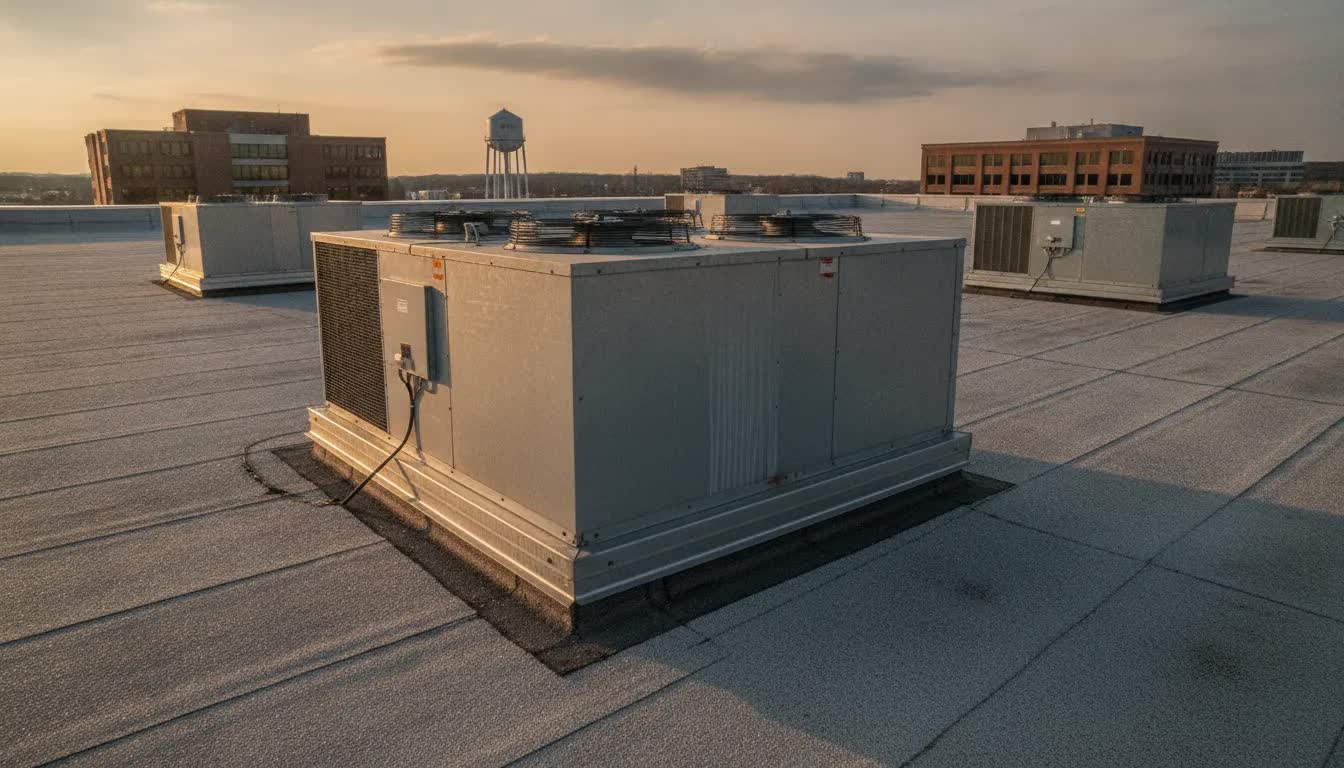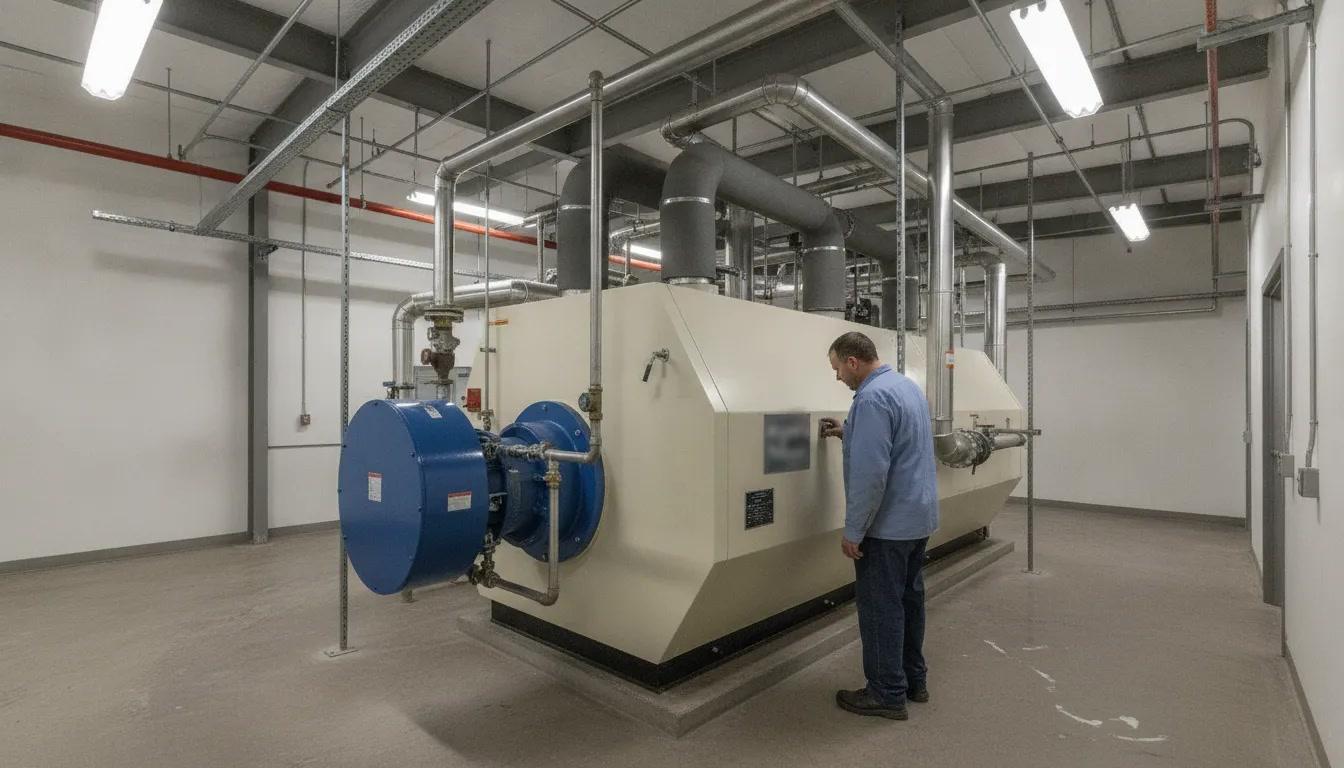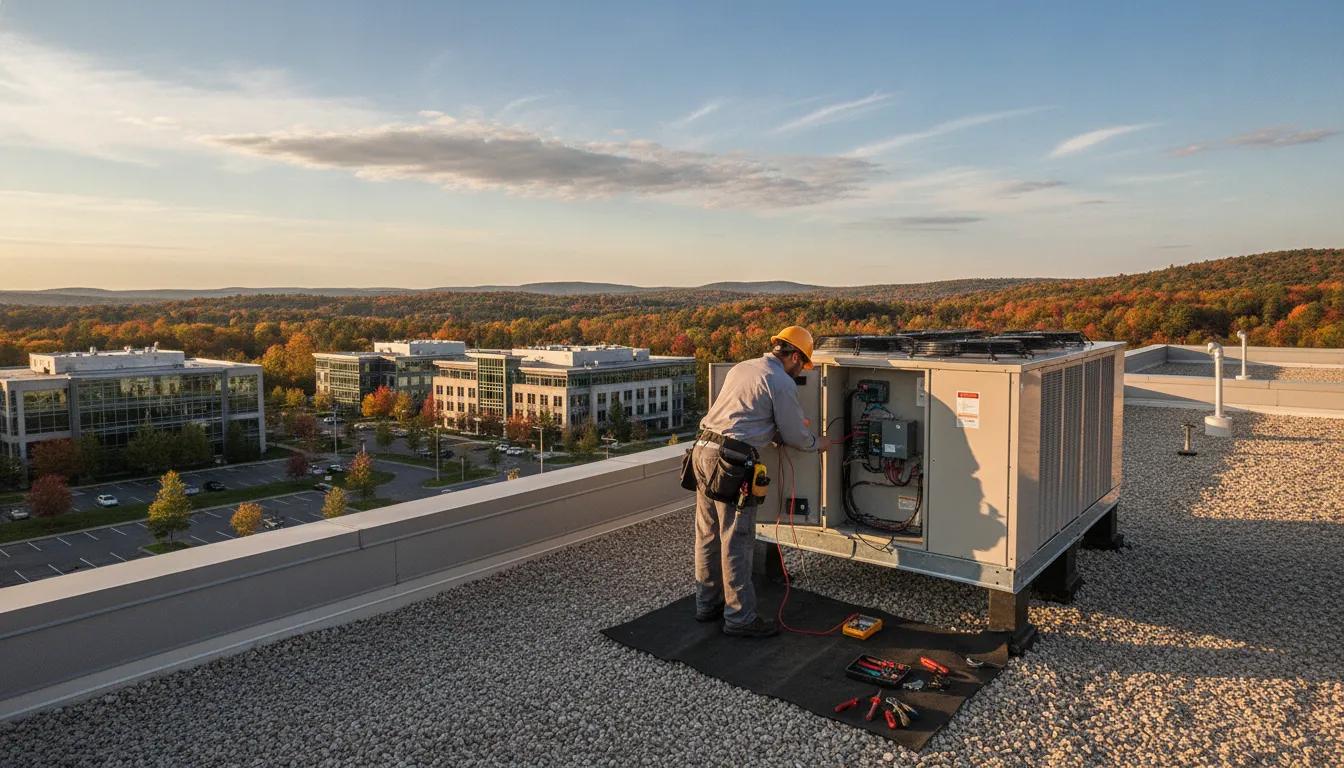
A warm sales floor and a normal office next door are not the same problem. Commercial air conditioning repair starts with that difference. One failed zone points at a single unit, a duct, or a control. A building that will not hold temperature points at something shared. B&B Mechanical Services has repaired and maintained commercial cooling for businesses in New Hampshire, Massachusetts excluding Cape Cod, and Rhode Island since 2000. This guide sorts the symptoms facility managers actually see. It does not replace a service visit, and it does not ask anyone on site to open a panel.
Call (978) 667-4644 to request commercial air conditioning repair. Tell us the building, the unit if you know it, and what the space is doing.
What commercial air conditioning repair is actually for
Commercial cooling is not a larger version of a home system. A rooftop or packaged unit often serves a whole floor, a sales area, or a kitchen. A split system or heat pump may cool one mechanical room, a server space, or a single zone. When that unit stops doing its job, staff, customers, and anything that needs stable temperature feel it at once.
The repair itself is the work after a diagnosis. A technician finds which part of the cooling cycle failed, explains the options, and starts only after the site approves the work. Filters, airflow, the refrigerant circuit, electrical parts, drains, and controls each fail in a different way. Guessing from the hallway wastes the visit.
Our commercial air conditioning repair page covers the equipment we service and how to request a visit. This article is the step before that call: how to read the symptom so the note is useful.
Three details matter before anyone talks about parts. Which rooms or floors are warm. Whether the unit sounds like it is running. And whether the problem showed up after a power blink, a renovation, or a change in how the space is used. Those three notes separate a local fault from a building-wide one.
One warm zone is a different call than a warm building
Start with the map of the complaint. If one office, one sales aisle, or one dining room is warm and the rest of the building is fine. The fault is usually on the unit or duct that serves that zone. If every zone drifts warm together, look for something shared: an outdoor condition, a control schedule, or a unit that feeds more than one area.
What a single warm zone usually means
A single warm zone often traces to airflow or to that unit's own components. A loaded filter, a closed damper, or a blocked return can starve one area while the rest of the building stays comfortable. A failed fan, a stuck control, or a refrigerant problem on that unit does the same thing. The rest of the building staying cool is useful evidence. It means the other units are still doing their job.
Write down the room names, not "the back of the store." Name the rooftop unit if it is tagged. Note whether the vent air feels weak, normal, or warm. Weak air and warm air are different faults. Weak air points at the fan or the duct path. Warm air with normal flow points at the cooling circuit.
What a whole-building drift usually means
When the whole building warms up, the cause is less likely to be one dirty filter. Outdoor heat, a schedule that set every unit back, or a shared control problem can move every zone at once. A recent change in occupancy matters too. A stockroom turned into a work area, or a kitchen line added to a sales floor, can outrun the unit that used to be enough.
Do not reset every thermostat to a lower number and wait. That hides the schedule the technician needs to see. Leave the setpoints where staff found them, and write those numbers down.
Short cycling, noise, and water each point somewhere else
Three symptoms get mixed together on repair calls. They are not the same fault, and they do not call for the same first check.
| What you notice | What it often means | What staff should do |
|---|---|---|
| One zone is warm. The rest of the building is fine. | A local airflow, control, or component fault. | Name the rooms and the unit tag. |
| The unit starts and stops again. | Short cycling from a control, charge, or safety. | Time the cycles. Then call. |
| Water pools at the unit. | A blocked drain, or a coil that iced and melted. | Keep people away. Report it. |
| Air feels weak at the vents. | A loaded filter, blocked coil, or duct restriction. | Note the filter if you can see it safely. |
A unit that starts and stops
Short cycling means the compressor or the fan starts, runs briefly, and shuts off, then repeats. On a commercial rooftop unit that pattern can come from a control, a refrigerant problem, or a safety that is doing its job. Research on packaged rooftop units has treated compressor short cycling as a common efficiency fault, not a quirk to ignore. Each restart adds wear and does less cooling than a normal run.
Staff can hear this from a safe spot. Count roughly how long the unit runs and how long it stays off. A unit that runs for a minute and rests for a minute is not "keeping up." It is stopping itself. Do not hold a reset button or bypass a safety to make it stay on. That can damage the compressor.
Noise is a mechanical clue, not a diagnosis
Grinding, squealing, or banging from a rooftop or packaged unit is a mechanical problem. It may be a fan, a bearing, or a loose panel. It is not something to tighten from the roof. Hissing near refrigerant lines is a reason to stay back, not a reason to look closer. Note the sound, the unit tag, and whether it happens at startup or the whole time the unit runs.
Water at the unit is often a drain, not a leak
Pooling water or heavy condensate usually means a blocked drain or a pan that is not emptying. It can also show up when airflow is so low that the coil ices and then melts. A blocked drain is a common, fixable service item. Water near electrical gear is not. Keep people away from standing water at the unit and report it. Do not pour water into the pan or poke the drain with a tool.
What low airflow and refrigerant problems look like
Two faults get blamed for almost every warm room. They leave different evidence, and only one of them is safe for staff to narrow down.
Low airflow
Low supply airflow shows up as weak air at the vents, a coil that ices, and a space that never quite catches up. The usual causes are a dirty filter, a blocked coil, a fan that was never set correctly, or a restriction in the duct. California Energy Commission research on rooftop units found that airflow below about 300 cubic feet per minute per ton of cooling cuts capacity and raises compressor power. If airflow drops far enough, the evaporator can ice, liquid refrigerant can reach the compressor, and the unit can start short cycling.
This is the one area where a facility check helps. Look at the filter access if it is a normal maintenance point and does not require opening an electrical cabinet. A filter packed with dust is worth reporting. It is not worth replacing with the wrong size just to get through the afternoon. Wrong filters collapse and make airflow worse.
Refrigerant charge
Refrigerant problems are not a filter job. The same rooftop research treated incorrect charge as one of the most common faults, from leaks or from poor service practice. A system charged well below the manufacturer's level can still blow air and still fail to keep the space cool, while using more power to do it. A California Energy Commission case study on rooftop fault detection reports about a 15 percent efficiency loss when charge sits about 20 percent below the nominal level.
Staff cannot confirm that from the thermostat. Frost on a line, a hiss, or oil stains near fittings are notes for the technician, not clues to act on. Federal rules are clear about who may work on the refrigerant circuit. Under EPA Section 608, technicians who attach gauges, add refrigerant, or recover it must hold the proper certification. Apprentices may do that work only while a certified technician supervises them closely. Nobody on the building staff should connect a gauge, add refrigerant, or open a service port. That work belongs on the service call.
What staff can check before requesting service
A useful check is anything staff can see or hear without tools and without opening equipment. The goal is a better note, not a repair.
- Confirm the complaint on a walk. Name the rooms that are warm and the rooms that are not.
- Read the thermostat or building display. Write the setpoint and the room temperature. Do not change a schedule you do not own.
- Note whether the unit seems off, running steadily, or starting and stopping.
- From a safe distance, listen for grinding, squealing, or banging, and note any burning or musty odor.
- Look for water at the unit or under ceiling diffusers. Keep people away if water is near electrical equipment.
- Ask what changed. A power interruption, a renovation, blocked returns, or doors propped open all belong in the note.
Stop if there is smoke, a burning smell, sparks, or a panel that is already open. Keep people away and follow the site's emergency steps. Do not open electrical cabinets, lift equipment covers, or touch refrigerant lines. Similar symptoms have different causes. An alarm code should be copied exactly as it appears, not translated into a part name.
If the building has a maintenance agreement, this is also the moment to say so when you call. Planned filter, refrigerant, electrical, and drain checks catch several of these faults before a hot week. Our commercial air conditioning maintenance checklist covers what those visits include. Repair is the right request when the space is already failing.
What to tell the technician so the visit starts in the right place
The first minutes of a commercial cooling call are spent finding the unit and the zone. A short note saves that time.
- Building name, street address, and the best contact on site.
- Which rooms or floors are affected, and which are still comfortable.
- Unit tag or location if you know it, such as "roof unit over the kitchen."
- When cooling last seemed normal, and whether the unit is off, short cycling, or running without cooling.
- Any displayed alarm, written down exactly.
- Water, odor, or unusual noise, and whether anyone already reset the unit.
Leave the setpoints alone until the technician has seen them. Repeated resets erase the pattern that explains a safety shutdown. If the same building also has walk-in coolers or freezers losing temperature, say that too. Product risk is a different clock than comfort cooling, and it should be on the same call note.
B&B Mechanical Services schedules service from the office after the call or the contact form comes in. Technicians diagnose the unit that is there. They explain the options before work starts. Same-day service is something we offer when location and technician availability allow it. It is not a promise that every call is completed the same day. We do not quote a price from a symptom list, and a phone note is not an estimate.
When the symptom is bigger than one repair
Some patterns mean the visit should include a repair-or-replace conversation, not only a part. Ask when the same repair has already come back in a short stretch. Ask when a compressor fails after years of short cycling. Ask when the space changed so much that the unit cannot keep up. A system that cools only in mild weather and falls behind on ordinary summer days belongs in that same conversation.
That conversation still starts with diagnosis. Age alone is not a reason to replace, and a warm afternoon is not proof the unit is finished. The technician needs to see whether airflow, charge, controls, or a failed component explain the complaint. If the equipment is at the end of its service life, replacement is one of the options we explain. It is not the assumption we arrive with.
Comfort complaints also need context. ASHRAE's thermal comfort guidance says there is no single correct thermostat number for every office. Clothing, activity, drafts, and surface temperatures all change how a room feels. A space that is 72 degrees and still draws complaints may be a comfort problem, an airflow problem, or both. Report the temperatures and the complaints. Do not assume the setpoint is wrong and keep pushing it down.
Frequently asked questions
What is the most common problem with a commercial air conditioner?
Airflow restrictions and incorrect refrigerant charge show up again and again on rooftop units. A loaded filter or blocked coil cuts the air the system can cool. Low charge, often from a leak or from earlier service, cuts capacity and raises power use. Staff can spot a filthy filter. They cannot confirm charge. Both still need a technician when the space will not hold temperature.
Can building staff add refrigerant or connect gauges?
No. EPA Section 608 requires certification for technicians who attach gauges, add refrigerant, or recover it from air-conditioning equipment. Apprentices may do that work only under close, continuous supervision by a certified technician. Report frost, hissing, or warm air. Leave the refrigerant circuit closed.
Does a warm room always mean the unit needs replacement?
No. One warm zone is often airflow, a control, or a failed component on that unit. Replacement comes up when the equipment cannot keep the space cool after those faults are ruled out, or when the same major failure keeps returning. The service visit is what separates those cases.
How is this different from an emergency outage?
An outage is a unit that is off, smoking, or putting people at risk. Follow site safety steps and request emergency service. This guide is for a system that is running poorly: one warm zone, short cycling, noise, or water. If you are unsure, call. Describe what you see and we will treat it with the urgency it needs.
Request service when the space will not hold temperature
Commercial air conditioning repair goes faster when the note names the zone, the unit, and the pattern. B&B Mechanical Services repairs rooftop units, packaged systems, split systems, and commercial heat pumps for businesses across New Hampshire, Massachusetts excluding Cape Cod, and Rhode Island. Call the office and we will get a technician started.
Call (978) 667-4644 to schedule service, or use the contact form if email is easier for your team.